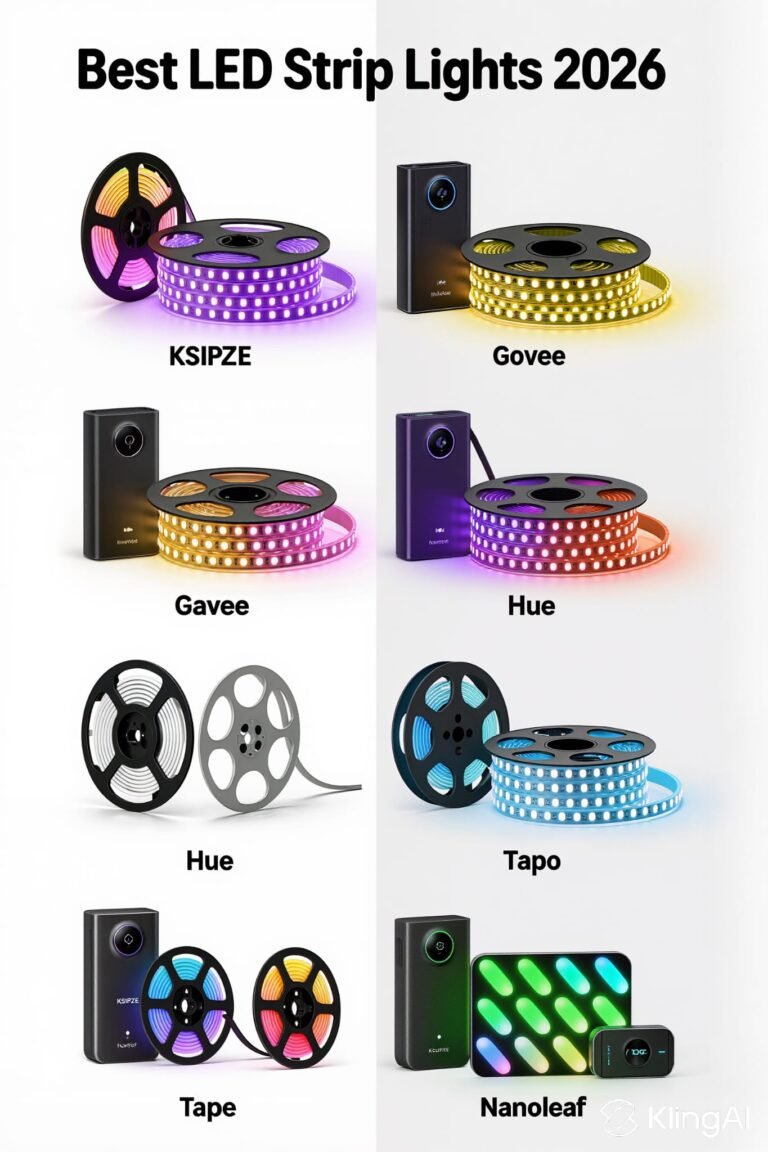
RGB LED strips are one of the biggest “room glow-up” trends on TikTok this back-to-school season, and it’s easy to see the appeal — for the price of a takeaway, a dorm room that looked like every other dorm room in the building suddenly looks like yours. But a dorm or shared student house has a set of constraints a homeowner simply doesn’t: you probably can’t drill or permanently glue anything to the wall without risking your deposit, your budget is tighter, and you’re usually lighting one desk wall or a headboard rather than an entire room perimeter. Our general LED Strip Lights guide covers the full market — this guide narrows it down specifically to what actually works, and what actually survives, in a rented room.
⚡ Quick Answer
For most students, the KSIPZE LED Strip is the safest starting point — it’s cheap enough that a bad landlord inspection isn’t a financial disaster, and a shorter run is easy to reposition. If you want genuine multi-colour effects and don’t mind spending more, Govee RGBIC gives the best “room glow-up” look. Whichever strip you choose, skip the permanent adhesive and mount it with removable Command-strip clips instead — it’s the difference between getting your deposit back and not.
Jump to a section
What Dorm Buyers Need That a Homeowner Guide Doesn’t Cover
- Removable mounting, not permanent adhesive: most LED strips ship with 3M adhesive backing meant to stay put for years — exactly what you don’t want on a wall you have to hand back in June
- Budget that survives a bad exam week: spending £60+ on lighting when textbooks are also due isn’t realistic for most students — budget picks matter more here than in a general buying guide
- Shorter runs, not whole-room perimeters: a single desk wall or headboard typically needs 2-5 metres, not the 10m+ runs aimed at living rooms
- Roommate-friendly control: a strip you can dim or switch off silently from an app beats fumbling for a physical remote at 1am when your roommate is asleep
- Cinderblock and textured dorm walls: many dorm rooms have painted cinderblock or heavily textured walls that standard strip adhesive genuinely struggles to grip
Best Dorm Room LED Strips: Comparison Table
| Strip | Dorm Budget Fit | Type | Best Run Length | Removable Mounting |
|---|---|---|---|---|
| KSIPZE LED Strip | Best budget fit — lowest risk if you have to remove it early | RGB | Easy to cut down to a single wall/desk run | Works well with Command strips as a swap-in for the stock adhesive |
| Govee RGBIC Strip | Higher spend, best visual “wow factor” for move-in videos | RGBIC | Good for a full headboard wall | Same swap-in approach recommended |
| Tapo L930 | Mid-budget, real RGBIC effects without the Govee price | RGBIC | Suits a desk or shelf run | Same swap-in approach recommended |
1. KSIPZE LED Strip — The Safe Starting Point
This is the strip we already stock and use ourselves, and it’s the one we’d recommend to a first-year student specifically because the low price makes it low-stakes — if it ends up not suiting your room, or you need to take it down mid-term, you haven’t lost much. It’s app-controlled with music sync and a remote included, and a single kit is easy to cut down to fit one desk wall or headboard rather than lighting an entire room.
✅ Pros
- Cheap enough that a dorm-room mishap isn’t a real financial loss
- App and music sync included at a budget price point
- Easy to cut down to exactly the length one desk wall needs
❌ Cons
- Standard RGB, not RGBIC — one colour along the strip at a time, not multi-colour segments
- Stock adhesive still isn’t removable — swap in Command strips before fitting (see below)
2. Govee RGBIC Strip — Best for the Move-In Video
If the goal is the flowing rainbow “room reveal” effect that does well on TikTok, this is the strip that actually delivers it, thanks to genuine RGBIC segments rather than a single flat colour. It costs more than a basic RGB strip, but for a headboard wall or a single accent run, that’s still a modest outlay compared to lighting a full room.
✅ Pros
- Genuine multi-colour RGBIC effects, not a single flat colour
- Best app and scene library in this comparison
- Strong built-in-microphone music sync, good for a shared common room too
❌ Cons
- More expensive than KSIPZE for the same run length
- Cannot be reconnected once cut, so measure your wall carefully first
3. Tapo L930 — The Middle Ground
A sensible compromise if KSIPZE feels too basic but Govee feels like too much to spend on a rental room. It’s genuine RGBIC at a price closer to a budget strip, connects straight to Wi-Fi with no separate hub, and fits neatly into a shorter desk or shelf run.
✅ Pros
- Real RGBIC multi-colour effects without Govee’s price tag
- No hub required — connects directly to your dorm’s Wi-Fi
- Works with Alexa/Google Assistant if you already use one
❌ Cons
- Shorter standard kit length than budget RGB options
- Fewer scenes/effects in the app than Govee
How to Mount Any of These Without Losing Your Deposit
The stock 3M adhesive on almost every LED strip is designed to stay put, which is exactly the wrong property for a room you have to return in the same condition you found it. The fix that actually works: instead of pressing the strip’s own adhesive backing directly onto painted cinderblock or dorm-issue paint, run a layer of removable mounting tape or small Command-brand clips along the wall first, then attach the strip to that. It holds just as well for a single academic year, and it comes off cleanly at move-out — the strip’s own adhesive is the part that leaves residue or pulls paint, not the light itself. Avoid textured or unpainted cinderblock entirely if you can position the run on a smoother section of wall instead; textured surfaces are the single biggest cause of strips falling down mid-term regardless of brand.
Verdict: Which Should You Actually Buy?
If this is your first LED strip and you’re not certain how much you’ll actually use it, start with KSIPZE — the price means getting it wrong costs you very little. If the visual effect is the whole point and you’re willing to spend more for it, Govee is worth the extra cost for a headboard or desk-wall run. Tapo L930 is the one to pick if you want real multi-colour effects but Govee feels like too much for a rental room. Whichever you choose, budget an extra few pounds for removable mounting tape or clips — it’s the cheapest insurance your deposit will ever get.
For the rest of your desk setup, see our Back-to-School Tech & Desk Setup Gadgets 2026 guide, and for the full market of LED strips beyond dorm-specific picks, see our main Best LED Strip Lights 2026 comparison.
This is one of four guides in our Back to School 2026: Complete Guide — see it for the full picture across desk setup, laptops, dorm lighting, and AI note-taking devices.
Dorm Room LED Strip Lights: FAQ
Will LED strips damage my dorm room walls?
The light itself won’t, but the stock adhesive backing can pull paint or leave residue on removal. Swap in removable Command-brand mounting tape or clips before fitting and this stops being a risk.
Do I need my own Wi-Fi, or does dorm Wi-Fi work?
Most university Wi-Fi networks work fine for app control, though some campus networks restrict device-to-device discovery — if the app can’t find your strip, check whether your dorm’s network has a guest/IoT mode or ask your IT department about device isolation settings.
How long a strip do I actually need for a dorm room?
Most single dorm rooms only need 2-5 metres for a desk wall or headboard run — buying a 10m+ kit meant for a full living room is usually unnecessary and wastes budget.
Will the lights bother my roommate?
App-controlled strips can be dimmed or switched off silently from your phone without fumbling for a remote in the dark, and most let you set a scheduled auto-off time — both worth using in a shared room.
Are these safe to leave on overnight?
LED strips run cool compared to older lighting types and draw very little power, but as with any electrical device, check your specific hall’s fire safety policy on decorative lighting before installing — some universities restrict certain lighting types in dorms.
📥 Get Our Free 2026 Digital Tools Stack
A free guide to the best hosting, VPN, cybersecurity and AI tools for 2026 — delivered straight to your inbox.
You Might Also Like
 Best Smart Ceiling Lights & Fan Lights 2026: Cool and Light a Room at Once
The best smart ceiling lights and fan lights of 2026 compared. We rank multi-colour fan lights, bladeless fans, Philips Hue, Yeelight, Govee and smart bulbs for every budget.
View Details Best LED Strip Lights 2026: KSIPZE vs. Govee, Hue, Tapo & Nanoleaf
The best LED strip lights of 2026 compared. We explain the RGB vs RGBIC difference that most buyers miss, and rank KSIPZE, Govee, Philips Hue, Tapo, Nanoleaf and Lepro.
View Details Smart Lights in 2026: The 5 Best Smart Bulbs Compared
Imagine walking into your home and the lights turn on just the way you like them—soft, warm, and…
View Details