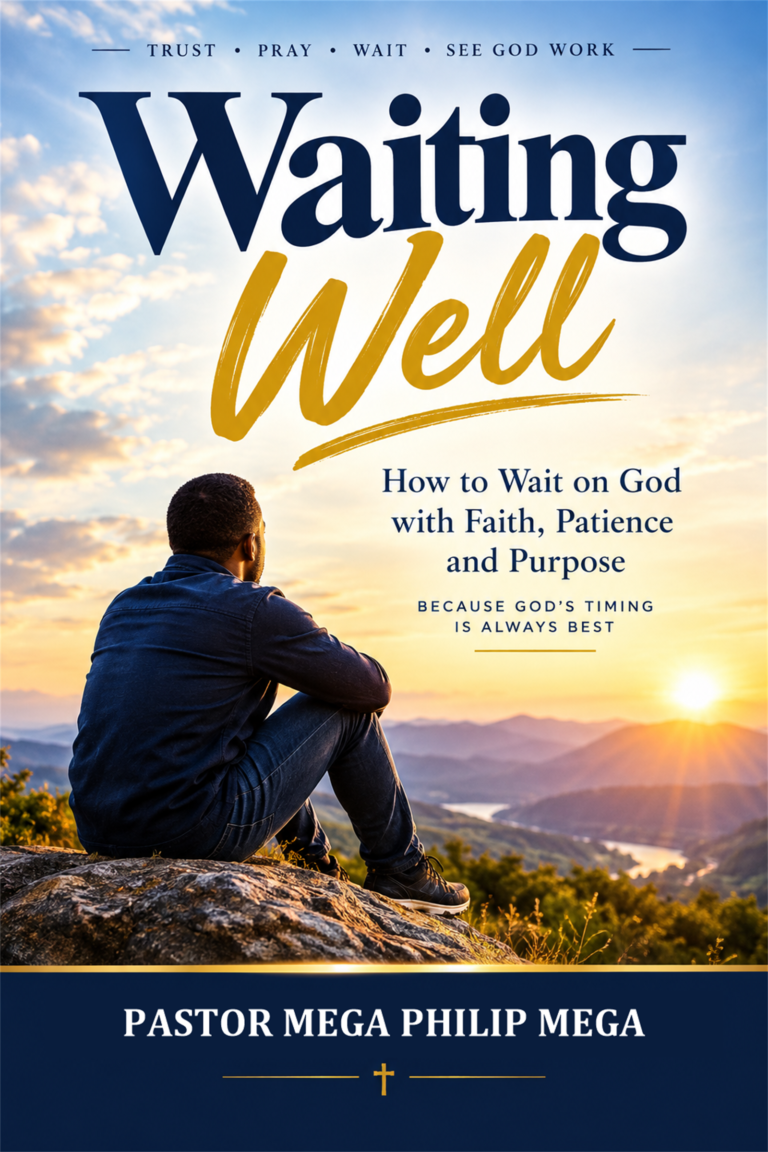
By Pastor Mega Philip Mega, author of The Driver and Stories That Build Faith.
When God feels silent, it does not mean he has left, and it does not mean your faith has failed. Scripture is full of faithful people who prayed and heard nothing for a long time. The silence was real for them, and so was God’s presence. This article looks at what the Bible shows about silent seasons, what silence does not mean, and five practical things to do while you wait.
If you are in one of those seasons now, you do not need a quick answer. You need honest company and a path you can walk today. Let us start there.
Jump to a section
You are not the first to feel this
The Bible does not hide the experience. The Psalms give it words:
“My God, my God, why have you forsaken me? Why are you so far from saving me, from the words of my groaning? O my God, I cry by day, but you do not answer, and by night, but I find no rest.” (Psalm 22:1-2, ESV)
“How long, O LORD? Will you forget me forever? How long will you hide your face from me?” (Psalm 13:1, ESV)
These prayers were not edited out of Scripture for sounding too raw. They were kept, sung and prayed by God’s people for centuries. Even Jesus took the opening words of Psalm 22 onto his lips on the cross (Matthew 27:46). If you have ever felt that your prayers hit the ceiling, you are in company that includes the psalmists and the Son of God.
Notice also where Psalm 13 ends: “But I have trusted in your steadfast love; my heart shall rejoice in your salvation” (Psalm 13:5, ESV). The psalmist does not pretend the silence is gone. He chooses what to hold onto inside it.
What God’s silence does not mean
- It does not mean God is absent. The book of Esther is the clearest example. God’s name never appears in it, yet his hand runs through every page: an orphaned girl becomes queen, a king has a sleepless night, a deadly plan turns around. In Stories That Build Faith, I describe this as God’s fingerprints rather than his voice. Sometimes you only see his work when you look back and connect the dots.
- It does not mean he does not love you. John records that Jesus loved Mary, Martha and Lazarus, “so, when he heard that Lazarus was ill, he stayed two days longer in the place where he was” (John 11:5-6, ESV). Love and delay sat side by side. Lazarus was not forgotten. The delay served something larger than anyone in that house could see.
- It does not mean your faith is too weak. Faith is not measured by how loudly you feel God. Isaiah speaks directly to the person in the dark: “Let him who walks in darkness and has no light trust in the name of the LORD and rely on his God” (Isaiah 50:10, ESV). The instruction is to trust in the dark, not to wait for the light before trusting.
- It does not mean no is coming. Silence and refusal are different things. Often silence is the space between a prayer and its answer, and the Bible is honest that the space can be long.
A fair question: could something be in the way?
Silence is not always only about waiting. Scripture gently invites us to check. “If I had cherished iniquity in my heart, the Lord would not have listened” (Psalm 66:18, ESV). This is not a verse to use for self-punishment. Most silent seasons have nothing to do with hidden sin, and a believer who assumes they do can spiral into guilt. But it is wise to ask God, calmly, “Is there anything I am holding on to that I need to bring to you?” If something comes to mind, confess it and receive his forgiveness. If nothing does, rest in that and do not go looking for a reason.
Abram’s long wait
Abram was seventy-five when God told him to leave his country, with a promise of a great nation (Genesis 12:1-4). He was a hundred when Isaac was finally born (Genesis 21:5). In between were years that looked, by any human measure, like the promise was impossible. He made mistakes in them. He feared in Egypt, he took matters into his own hands with Hagar, and he laughed in disbelief when the promise was renewed.
And yet Scripture calls him God’s friend (James 2:23). As I write in Stories That Build Faith, friendship is built through the slow accumulation of trust over time, through a relationship that survives failure and keeps walking anyway. If your own season of waiting has produced doubts and stumbles, Abram’s story says God is far more patient with slow, faltering faith than we tend to be with ourselves.
Five things to do while you cannot hear him
1. Open the map
In The Driver, I describe God’s Word as the map and his Spirit as the voice. When the voice seems quiet, the map is still in your hands. “Your word is a lamp to my feet and a light to my path” (Psalm 119:105, ESV). A lamp in the ancient world lit the next few steps, not the whole valley. You may not know the next ten decisions, but Scripture can show you honesty, faithfulness, generosity and love for today. Walk in that, and the next step often becomes clear.
2. Remember that faith is not a feeling
Some days you feel nothing at all: no peace, no assurance, only the rumble of the road. It is tempting to conclude that your faith has failed. But faith is a decision to rely on what God has said, not a mood. Feelings rise and fall like hills on a country road, while God’s promises stay level. “Heaven and earth will pass away, but my words will not pass away” (Matthew 24:35, ESV). Say out loud what you know to be true: he is faithful, he is good, he is driving. In time the feelings often follow the faith.
3. Look at the road behind you
When the road ahead is dark, look back. The prayers he has answered, the doors he has opened, the dangers he has carried you through, the people he sent at just the right time: these are road signs of his faithfulness. The God who has driven you this far has not changed. Write down three moments when he clearly carried you, and read them when the silence is loudest.
4. Keep doing what you did before the silence
Daniel prayed three times a day, and when a decree made prayer dangerous, he did it again “as he did aforetime” (Daniel 6:10). His faithfulness did not depend on feeling a response. It was a settled habit. In the same way, a silent season is not the time to abandon your rhythms of prayer, Scripture and fellowship. Vague intentions rarely survive pressure, but a specific, repeated practice does. Keep your appointment with God even when it feels like talking to an empty room.
5. Obey the last thing you clearly heard
Often the most useful question is not “Why is God quiet?” but “What did he last say that I have not yet done?” In Unusual Obedience, I write about Joshua, who was told to march around Jericho in silence for six days before anything happened. Nothing about it looked like progress. Obedience in the quiet stretch was the whole point. If there is an act of obedience, forgiveness, restitution or generosity that you have been putting off, doing it is often the best way through the silence.
Do not wait alone
“In an abundance of counselors there is safety” (Proverbs 11:14, ESV). Silent seasons are harder in isolation. Tell a trusted pastor or mature friend. Ask them to pray with you and to tell you honestly what they see. If the silence comes with deep sadness, hopelessness or thoughts of harming yourself, please speak to a doctor or a counsellor as well. Seeking medical help is not a lack of faith. It is another form of care God provides.
When the silence breaks
Habakkuk was told, “For still the vision awaits its appointed time; it hastens to the end – it will not lie. If it seems slow, wait for it; it will surely come; it will not delay” (Habakkuk 2:3, ESV). When the answer comes, it may not look like what you expected. But people who have waited faithfully often say the same thing afterwards: that God was nearer than they knew, and that the waiting shaped them in ways a quick answer could not have.
Questions to ask yourself
- Which prayer have I stopped praying because I no longer expect an answer?
- What did God last make clear to me, and have I done it?
- What three moments in my past show his faithfulness?
- Which of my spiritual habits have I let slip during this season?
- Who can I tell this week, honestly, how I am doing?
Frequently asked questions
Why is God silent when I pray?
There is no single answer, and the Bible does not promise you an explanation for every season. It does show that silence is not the same as absence, that waiting can serve purposes we cannot yet see, and that God’s people have always prayed honestly through it.
Is God punishing me with silence?
Not necessarily, and usually not. Ask him honestly whether anything needs to be confessed. If nothing comes to mind, do not search for a reason to blame yourself. Christ has dealt with our sin, and a quiet season is not evidence of punishment.
Is it normal to doubt when I cannot hear God?
Yes. The psalmists, Abram and Sarah all voiced doubt, and Scripture does not hide it. Doubt brought honestly to God is very different from doubt used as a reason to walk away.
How long will the silence last?
Scripture does not give a number. What it gives is a character to trust: the one who is faithful across years, as with Abram, and across dark nights, as with Esther’s people.
What if I never feel his presence again?
Feelings change, but his promise does not: “I will never leave you nor forsake you” (Hebrews 13:5, ESV). Faith rests on that promise, not on how you feel this morning.
A prayer
Lord, I cannot hear you the way I want to, but I know who you are. Keep me from reading your silence as absence. Help me to open your Word, to remember your faithfulness, and to obey what you have already made clear. Hold me through the quiet stretch, and let me trust you in the dark as I would in the light. Amen.
This article is drawn from chapters 4 and 5 of The Driver: Trusting a Driver You Cannot See and from the chapters on Abram, Daniel and Esther in Stories That Build Faith. Related reading: Joseph’s hidden years: waiting on God and Integrity when no one is watching.
You Might Also Like
 The Compromise Trap: How Integrity Erodes One Small Choice at a Time
Nobody decides to destroy their integrity. How compromise works, what David's story shows, where guardrails belong, and the grace available when you have drifted.
View Details Questions to Ask Before Getting Engaged: A Christian Checklist
A Christian checklist of questions to ask before getting engaged: conflict, money, family, calling, readiness and the church. Count the cost before the ring.
View Details
Is Dating Biblical? Courtship vs Dating for ChristiansIs dating biblical? The Bible gives principles, not a single courtship system. Here is how courtship and dating differ, and what intentional dating looks like.
View Details If Marriage Never Comes: Living a Full Life Single
What if you never marry? The Bible offers a real promise, the example of Jesus and Paul, and a legacy that does not depend on a wedding ring.
View Details