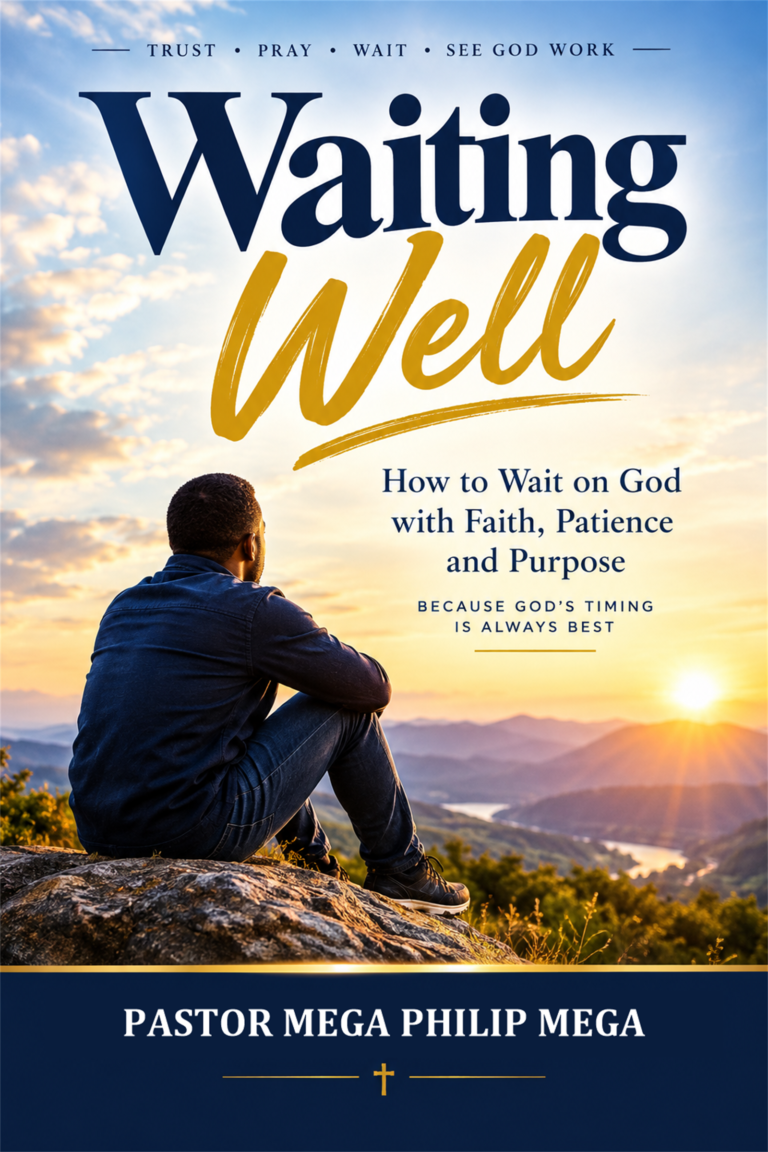
By Pastor Mega Philip Mega, author of Waiting Well.
A whole life has never depended on a wedding ring. If marriage never comes for you, the Bible does not answer with damage control. It offers a real promise, a real example in Jesus and Paul, and a real picture of a legacy that is not measured by a spouse or by children of your own.
Somewhere, late at night, almost every single Christian eventually asks the question underneath all the others: what if this is permanent? It deserves a real answer, not a hurried reassurance on the way to a more comfortable topic. Let us look at one honestly.
Jump to a section
The question underneath the others
Most advice for singles quietly assumes that marriage is coming, so the only task is to wait well. That is a good task, and it is worth doing. But it can leave a harder question unanswered. If you stop assuming the wedding is on its way, what is left? Is the life ahead of you a lesser one?
The desire for marriage is good, and its absence is a real loss. You are allowed to feel that. But alongside that honest grief, Scripture says something that surprises many people.
A name better than sons and daughters
In the ancient world Isaiah wrote into, a eunuch faced exactly this kind of permanence. He was excluded by circumstance from marriage and from biological children, the two things a legacy was assumed to require. Isaiah’s word to such people was not pity:
“To the eunuchs who keep my Sabbaths, who choose the things that please me and hold fast my covenant, I will give in my house and within my walls a monument and a name better than sons and daughters; I will give them an everlasting name that shall not be cut off.” (Isaiah 56:4-5, ESV)
Read that slowly. It is not a consolation prize, and it is not “it is okay, you will still be loved despite missing out.” It is a name better than sons and daughters, an everlasting one, where biological legacies eventually fade. That promise was given to people excluded by circumstance, and it shows the heart of God toward anyone who stays faithful in the situation they fear. A whole, remembered life never depended on marriage or children.
Jesus and Paul lived whole lives unmarried
Jesus lived his entire earthly life unmarried and without children of his own, and he left a legacy no family tree in history has matched. That is not a rhetorical trick to make you feel better. It is the plainest evidence that a complete, world-changing life was never dependent on marriage.
Paul, also unmarried, wrote, “I wish that all were as I myself am. But each has his own gift from God, one of one kind and one of another” (1 Corinthians 7:7, ESV). The Bible treats singleness and marriage as two real ways of living, each with its own gift, not as a complete life and an unfinished one.
A legacy that is not biological
If marriage never comes, your legacy is not erased. It takes a different shape:
- The people you have discipled or mentored, who carry your faith forward.
- The ministry, ideas, work or art that outlast you.
- The honest, faithful life you have lived, which others will remember and learn from.
Spiritual children are still children in every way Scripture cares about. Paul wrote to the Corinthians, “For though you have countless guides in Christ, you do not have many fathers. For I became your father in Christ Jesus through the gospel” (1 Corinthians 4:15, ESV). He called whole churches his offspring, without any hint of irony or compensation.
Who are the spiritual children already in your life? Think of the people you have shaped, mentored, prayed for or discipled, some of whom you may not have thought of in those terms.
Sit with the question, do not rush past it
This article cannot remove the ache of the possibility, and it should not remove it entirely. The desire for marriage is a good desire, and if its answer never comes, that is a loss worth grieving. Do not skip that grief. Hannah wept in the temple and the Bible does not correct her. Bring the ache to God plainly.
But hold something else alongside it: your life, married or not, was never going to be validated by a wedding ring. It was already, from the beginning, a life God intended to be whole in him.
Guard against the root of bitterness
There is a turn worth learning to recognise. You are scrolling past someone’s engagement photos, you feel the familiar sting of grief, and then it curdles into something sharper: resentment toward the couple, toward God or toward yourself. Grief mourns. Bitterness accuses.
The writer of Hebrews gives an exact image: “See to it that no one fails to obtain the grace of God; that no ‘root of bitterness’ springs up and causes trouble, and by it many become defiled” (Hebrews 12:15, ESV). A root grows underground before it breaks the surface. Comparison is usually how it starts, measuring your ordinary Tuesday against someone else’s best Saturday, because “when they measure themselves by one another and compare themselves with one another, they are without understanding” (2 Corinthians 10:12, ESV).
Three things help. Name the resentment honestly to God, even the ugly thoughts. Practise genuine celebration for others, showing up, giving the gift, even when it costs you at first, because repeated practice tends to produce the real thing. And be wise about your social media: if a certain feed reliably leaves you diminished, muting it for a season is wisdom, not weakness.
A four-week rhythm to begin
You do not become a person at peace in a single decision. You become one a week at a time. Here is a simple rhythm to try, adapted from the closing chapter of Waiting Well:
- Week one: name and grieve. Write down what you have been living provisionally about, and what you honestly grieve. Bring both to God without rushing to a tidy conclusion.
- Week two: set one boundary. Choose one recurring conversation, expectation or platitude, and respond to it kindly and clearly, out loud, with one real person.
- Week three: build one thing. Take one step toward a fuller life now: invest in a friendship, take a step in your calling, or make a home or money decision you have been postponing.
- Week four: bless out of your own healing. Do one act of genuine celebration for someone further along a path you are still walking.
Repeat it as often as you need. It is not a technique for making marriage arrive faster. It is a way of living well in whatever this season turns out to be.
Questions to ask yourself
- Have I honestly let myself sit with the possibility that marriage may not come? What comes up when I do?
- What would “a name better than sons and daughters” look like in the life I am already building?
- Who are my spiritual children, the people I have shaped, mentored or discipled?
- Where does comparison find me most easily: a person, a platform or a season of the year?
- What is one sentence I want to be able to say about this season, looking back on it someday?
Frequently asked questions
Is it wrong to fear I will be single forever?
No. It is a natural fear, and many faithful people have felt it. Bring it to God honestly rather than burying it. The fear is not a failure of faith, and the Bible gives you real things to hold alongside it.
Does the Bible promise every believer a spouse?
No. Scripture honours marriage, but it never promises one to every believer. Paul says “each has his own gift from God” (1 Corinthians 7:7, ESV). That means your life can be whole, faithful and fruitful with or without a spouse.
Should I stop praying for a spouse?
No. You can keep wanting, praying and taking wise steps while also building a life that does not wait on the answer. Hope and wholeness are not opposites.
What about loneliness?
Loneliness is real. It helps to invest in deep friendships, in a church community and in people you can serve, rather than treating those relationships as placeholders. For more on this, read How to Be Content While Single.
A prayer
Lord, if this season is permanent, let it be no less whole for that. Give me an everlasting name in you, not dependent on what I do or do not receive from another person. Meet me in my grief, guard me from bitterness, and show me the spiritual children you have placed in my life. Amen.
This article is drawn from chapters 5, 9, 11 and 12 of Waiting Well: A Christian’s Guide to Singleness Without Settling. Related reading: How to be content while single (without giving up) and Singleness is not a waiting room.
Keep reading
- The Pressure to Settle: How Christian Singles Can Choose Wisely
- Joseph’s Hidden Years: Waiting on God
- Free tool: a Bible verse wallpaper that changes on its own
- All of Pastor Mega Philip Mega’s books
You Might Also Like
 The Compromise Trap: How Integrity Erodes One Small Choice at a Time
Nobody decides to destroy their integrity. How compromise works, what David's story shows, where guardrails belong, and the grace available when you have drifted.
View Details Questions to Ask Before Getting Engaged: A Christian Checklist
A Christian checklist of questions to ask before getting engaged: conflict, money, family, calling, readiness and the church. Count the cost before the ring.
View Details
Is Dating Biblical? Courtship vs Dating for ChristiansIs dating biblical? The Bible gives principles, not a single courtship system. Here is how courtship and dating differ, and what intentional dating looks like.
View Details How to Be Content While Single (Without Giving Up)
How can a Christian be content while single and still want marriage? Contentment is learned, not performed, and it is not giving up. Here is how to build a full life now.
View Details