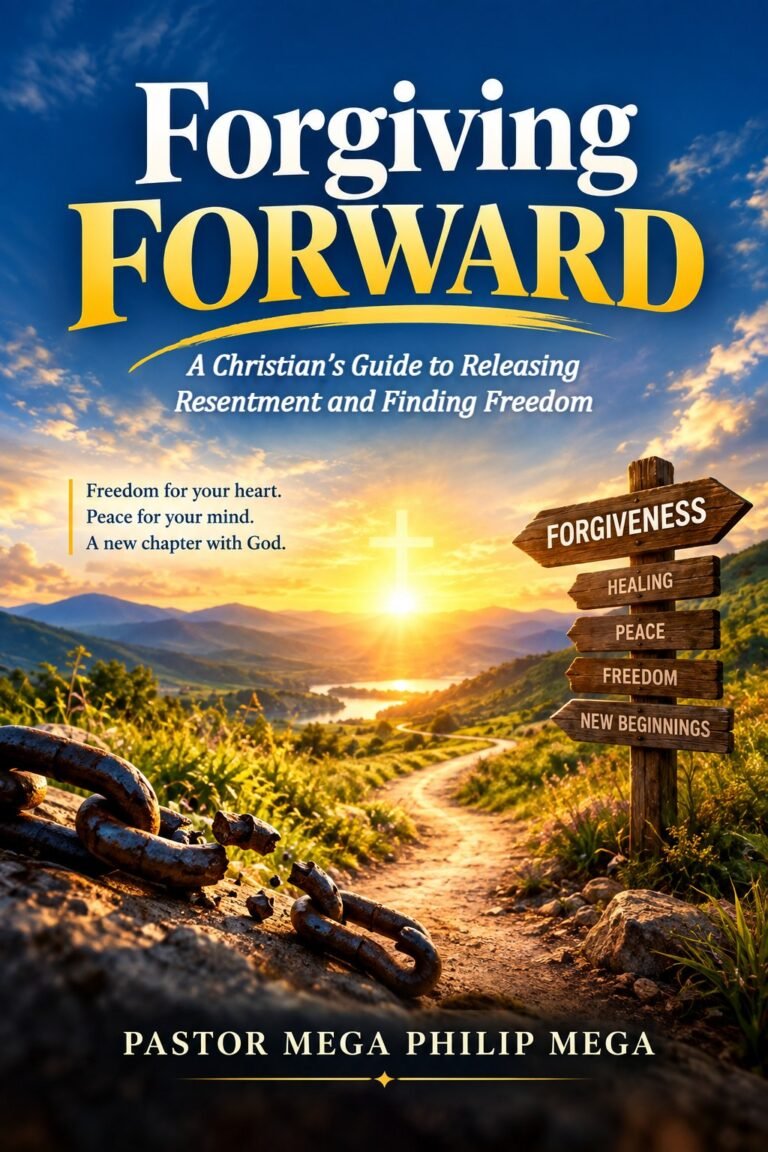
By Pastor Mega Philip Mega, author of Forgiving Forward.
Somewhere in most of us is a ledger we never asked for and cannot quite put down. It keeps a precise account of what was said, what was done, what was taken, and it waits patiently for the balance to be settled. The trouble is that the balance almost never gets settled the way the ledger demands. The apology never quite matches the wound. The consequence the other person faces never quite equals what you lost. And so the ledger stays open, sometimes for years, quietly running interest on a debt that was never going to be repaid in the currency we wanted.
Jump to a section
A story about an impossible debt
Jesus told a story about a servant who owed his king an amount so large it could never realistically be repaid. The king simply cancelled it, in full, on the spot. That same servant then found a fellow servant who owed him a few months’ wages, seized him by the throat, and had him thrown into prison until the debt was paid.
“Should you not have had mercy on your fellow servant, as I had mercy on you?”
Matthew 18:33 (ESV)
The story is uncomfortable on purpose. Most of us picture ourselves as the one still owed. But Jesus is telling a story about you, standing in front of a King who has already cancelled a debt you could never have repaid.
Why so many people cannot forgive
Before forgiveness can be understood, it usually has to be rescued from several counterfeits wearing its name. Many people who believe they cannot forgive are actually refusing something forgiveness never asked of them in the first place. And many who believe they have forgiven have only performed one of these counterfeits instead, which is why the anger keeps returning as if it was never dealt with at all.
Four things forgiveness is not
1. Forgiveness is not excusing
To excuse something is to say it was not really wrong, or not really their fault. Forgiveness requires the opposite starting point: naming the wrong honestly, without softening it, and choosing to release the offender anyway. You cannot forgive what you have talked yourself into believing never happened. Minimising the wound and forgiving it are not the same movement. One is denial wearing forgiveness’s clothes.
2. Forgiveness is not forgetting
Memory is not a moral failure. You can forgive a betrayal completely and still remember exactly what happened, the way Joseph never forgot being sold by his brothers even as he forgave them decades later. Forgetting is not the goal, and often not even possible. What changes is not your memory of the event but its grip on your present.
3. Forgiveness is not reconciliation
“If possible, so far as it depends on you, live peaceably with all.”
Romans 12:18 (ESV)
Notice the qualifiers: if possible, so far as it depends on you. Paul assumes some relationships will not be restored, for reasons outside your control. Forgiveness is something you do internally, before God, whatever the other person does next. Reconciliation is a restored relationship, and it requires two willing, safe participants.
4. Forgiveness is not trust
Trust is earned back through a pattern of trustworthy behaviour over time. Forgiveness can be granted in a moment. Trust almost never can, and demanding otherwise sets people up to be hurt again by someone who has not actually changed. You can forgive a father for breaking his promises for decades and still, wisely, not hand him your car keys tomorrow.
Why the ledger feels so justified
The ledger persists because it feels like justice, not bitterness. Keeping score seems like the responsible thing to do, proof that what happened actually mattered. Forgiveness can sound, from the outside, like agreeing to stop caring whether justice ever happens. That fear deserves to be taken seriously. But the ledger itself was never going to deliver the justice it promised. It only ever delivered a longer accounting of pain, kept by the one person guaranteed to suffer from carrying it: you.
Questions to ask yourself
- What ledger have you been keeping, consciously or not, against someone who hurt you?
- Which counterfeit (excusing, forgetting, forced reconciliation or premature trust) have you mistaken for forgiveness before?
- What would it cost you to imagine that debt as already cancelled, not by the other person’s effort, but by grace?
Frequently asked questions
Does forgiving someone mean what they did was okay?
No. Forgiveness begins by naming the wrong honestly. It releases the claim you hold against the person without pretending the harm did not matter.
Do I have to feel forgiving?
Forgiveness is a decision made before God, not a feeling you manufacture. Feelings often follow slowly, and the decision may need to be renewed.
Can I forgive someone who has not apologised?
Yes. Forgiveness is a transaction between you and God. It does not depend on the other person’s apology or cooperation.
This article is drawn from chapters 1 and 2 of Forgiving Forward: A Christian’s Guide to Releasing Resentment and Finding Freedom. Related reading: Can you forgive without reconciling?
Keep reading
- Can You Forgive Without Reconciling? What the Bible Shows
- When to Walk Away From a Relationship: A Christian Guide Without the Guilt
- Free tool: a Bible verse wallpaper that changes on its own
- All of Pastor Mega Philip Mega’s books
- Boundaries Are Not Bitterness: Can You Set Limits and Still Forgive?
You Might Also Like
 The Compromise Trap: How Integrity Erodes One Small Choice at a Time
Nobody decides to destroy their integrity. How compromise works, what David's story shows, where guardrails belong, and the grace available when you have drifted.
View Details Boundaries Are Not Bitterness: Can You Set Limits and Still Forgive?
Can you forgive someone and still set limits with them? Yes. Forgiveness releases the debt, and a boundary decides future access. Here is how the two work together.
View Details
Integrity When No One Is Watching: Holy in PrivateWhat you do when no one is watching is what God sees. Daniel, Joseph and Jesus on private integrity, plus a practical way to guard one room this week.
View Details When God’s Instructions Don’t Make Sense: Unusual Obedience
What to do when God's instruction collides with logic: why He gives strange instructions, what obedience costs, and seven practical steps.
View Details