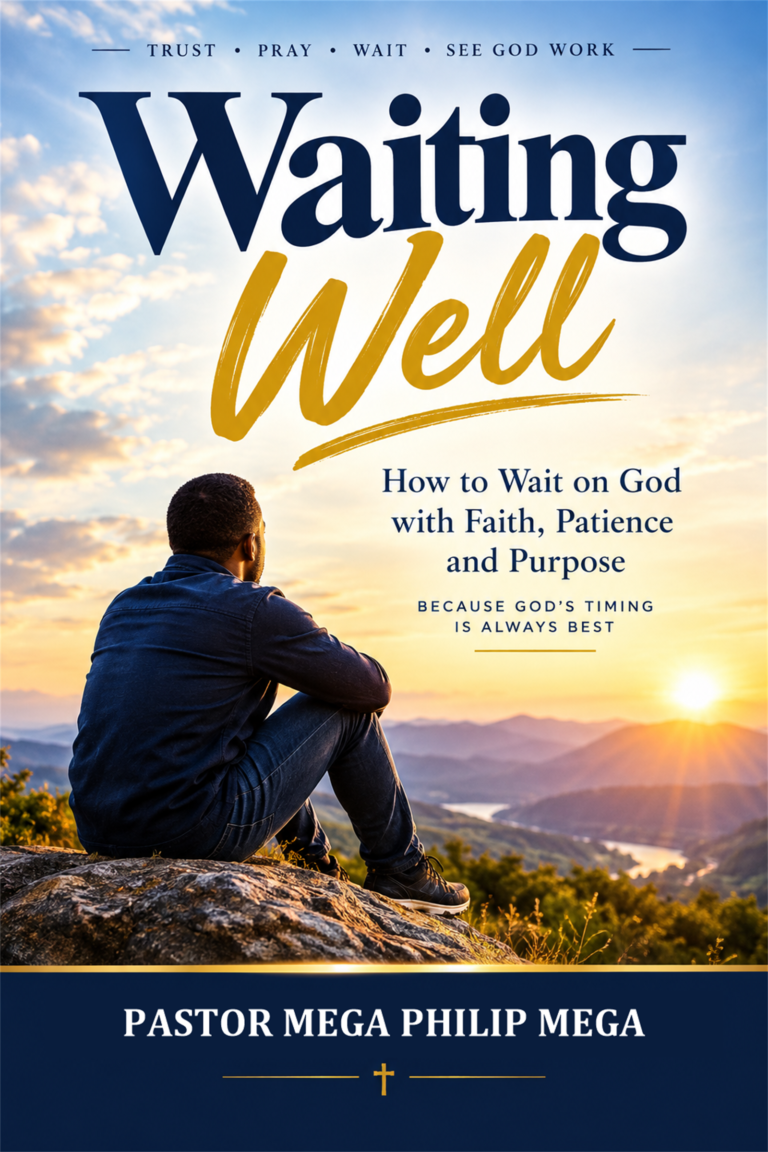
By Pastor Mega Philip Mega, author of Waiting Well.
Contentment is something you learn, not something you perform, and it is not the same as giving up. You can be content while still wanting to be married. You can grieve what has not happened yet and still trust God. Contentment simply means your peace is no longer controlled by an unmet desire. It does not mean the desire has disappeared.
If you have tried to “just be content” and ended up feeling worse, this article is for you. Here is what the Bible says, what contentment is not, and how to build a full life now.
Jump to a section
The trap: “Stop wanting it, and God will send it”
Somewhere along the way, a strange piece of folk theology took root in many churches: if you would just stop wanting marriage so much, God would finally send it. Contentment gets taught as a spiritual trick. Fake the peace convincingly enough, and you are rewarded for it.
That is not contentment. It is bargaining wearing contentment’s clothes, and it does not work, because it was never what Paul meant.
Contentment is learned, not performed
“For I have learned in whatever situation I am to be content… I can do all things through him who strengthens me.” (Philippians 4:11-13, ESV)
Notice the verb. Paul does not say he arrived at contentment, or that it descended on him once he prayed the right way. He says he learned it. That is the word you would use for a skill built slowly, through repetition, often in the very circumstances that make it hardest. Paul wrote these words from prison. His contentment was not the absence of a situation he would have chosen differently. It was the presence of a strength that did not wait for the situation to change.
That matters for you. Contentment is not the disappearance of your desire for marriage. You are allowed to still want it, plan for it, actively pursue it and be content, all at once. Contentment is simply not being controlled by the unmet desire: not staking your peace, your joy or your sense of God’s goodness on whether this longing is answered on your preferred timeline.
Contentment is not numbness
There is an opposite mistake. Hearing “learn contentment,” some people quietly decide the safest move is to stop hoping altogether, to flatten the desire so it cannot hurt them any more. That is not maturity. It is self-protection in spiritual clothing, and it tends to leak out sideways as cynicism about marriage, or about the people in it.
Real contentment can sit alongside real grief. You can cry at your third friend’s wedding this year and still be content. You can want this badly and not be shaken by another year passing without it. These are not contradictions. They are what it looks like to hold a real desire with an open hand instead of a clenched fist.
You are allowed to grieve
There is a particular grief that has no funeral, because nothing has technically been lost. It shows up at a baby shower, at a wedding table full of singles, or while scrolling past an anniversary post late at night. It is grief for a life that has not happened, and might not. Because nothing “died,” many people never feel they have permission to grieve it.
Scripture makes room for it. Hannah wept so bitterly and prayed so long over her childlessness that the priest Eli assumed she was drunk: “In her deep anguish Hannah prayed to the Lord, weeping bitterly” (1 Samuel 1:10, NIV). Her grief was not quiet or tidy, and the text never corrects her for feeling it. Faith and sorrow are not opposites. Hannah did both in the same prayer.
Be specific if you can. Vague sadness is hard to bring to God, but specific grief is easier to pray: the empty side of the bed, the “and guest” line, the good news with no one built in to tell first. Naming these does not make you dramatic. It makes the grief small enough to hand to God.
What contentment looks like in an ordinary week
Contentment is less a single decision than a daily practice. It looks like:
- Noticing the moment your peace starts depending on an outcome you do not control, and consciously handing it back to God.
- Celebrating someone else’s engagement without the celebration costing you something inside.
- Making real plans, for your home, career and friendships, without a silent asterisk that says “until marriage makes this count.”
Slowly and unevenly, the way any skill is learned, you stop waiting to start living.
See what this season makes possible
Paul wrote, “The unmarried man is anxious about the things of the Lord, how to please the Lord. But the married man is anxious about worldly things, how to please his wife, and his interests are divided” (1 Corinthians 7:32-34, ESV). This is not an insult to marriage. A spouse’s wellbeing rightly becomes your concern, and that takes real time and energy. But it means something is also true in reverse: your undivided attention now is not a smaller thing than marriage. It is a different capacity, available because of the season you are in.
That might look like being the friend who can drop everything on a Tuesday afternoon, saying yes to a mission trip or a move, or sitting unhurried in a hospital waiting room because your evening belongs to no one else. Two wrong turns are worth naming. One is feeling superior to married friends. The other is guilt, hearing “you have more capacity” as “your singleness only counts if you are productive for God.” You are allowed to rest and to have ordinary days. The point is not that you owe God extra output. It is that something good is available to you now, and it would be a shame to spend the whole season not noticing it.
Build a full life now
Picture two single people. One has rented month-to-month for years “just in case,” avoided deep friendships that might complicate things once a spouse arrives, and delayed a ministry role because it felt safer to wait. The other bought a small home, built a few friendships so deep they are like family, leads a ministry they love and has been saving for the long term. Same relationship status, very different lives. The difference was never marriage.
- Friendship. Scripture’s model of deep friendship stands on its own. “Jonathan made a covenant with David, because he loved him as his own soul” (1 Samuel 18:3, ESV). Invest in friendships like that for their own sake, not as placeholders.
- Calling. Step into the ministry or work you are equipped for now. Lead the class, take the trip, start the project. None of it is more legitimate with a ring on your hand.
- Home. Make it a real home, not a waypoint. Host people at your table. A home lived in fully now is not wasted if a spouse joins you, and it is not a loss if one never does.
- Finances. Plan as the long-term adult you already are, with savings, an emergency fund and a will. “Someday” thinking about money is waiting-room thinking with a spreadsheet.
Questions to ask yourself
- Have I ever treated contentment as a bargaining tool, performing peace in the hope it would “work”? What happened?
- Where is the line, for me, between healthy hope and being controlled by an unmet desire?
- What specifically do I grieve, in plain words?
- Where am I still living “month-to-month,” literally or figuratively, in a way marriage would not actually fix?
- What would change this week if my peace stopped depending on my relationship status?
Frequently asked questions
Is it wrong to want to be married?
No. You are allowed to want marriage, plan for it and pursue it, and be content at the same time. Contentment is not being controlled by the desire, not removing it.
Does being content mean I should stop looking for a spouse?
No. Contentment is about where your peace rests, not about whether you take wise steps. You can be open, prayerful and active while refusing to stake your peace on the timeline.
How do I cope with weddings and baby showers?
Let yourself feel what you feel, and bring it honestly to God, as Hannah did. Name what hurts. Over time, practise celebrating other people’s joy without it costing you something inside. It is a skill, and it grows slowly.
What if “just trust God” makes me feel worse?
Trust is true, but said too quickly it can skip past real pain. Many of the Psalms are laments that name the pain honestly before landing on trust. Honest grief first often makes trust deeper, not thinner.
A prayer
Lord, teach me contentment the way Paul learned it, not as the absence of desire, but as a strength that does not wait for my circumstances to change first. Meet me in what I grieve. Show me what this season makes possible, and help me to build a full life now. Amen.
This article is drawn from chapters 2, 4, 5 and 7 of Waiting Well: A Christian’s Guide to Singleness Without Settling. Related reading: Singleness is not a waiting room and The pressure to settle: how Christian singles can choose wisely.
Keep reading
- Joseph’s Hidden Years: Waiting on God
- Discerning God’s Will in a Relationship Without Waiting for a Neon Sign
- Free tool: a Bible verse wallpaper that changes on its own
- All of Pastor Mega Philip Mega’s books
- If Marriage Never Comes: Living a Full Life Single
You Might Also Like
 The Compromise Trap: How Integrity Erodes One Small Choice at a Time
Nobody decides to destroy their integrity. How compromise works, what David's story shows, where guardrails belong, and the grace available when you have drifted.
View Details Questions to Ask Before Getting Engaged: A Christian Checklist
A Christian checklist of questions to ask before getting engaged: conflict, money, family, calling, readiness and the church. Count the cost before the ring.
View Details
Is Dating Biblical? Courtship vs Dating for ChristiansIs dating biblical? The Bible gives principles, not a single courtship system. Here is how courtship and dating differ, and what intentional dating looks like.
View Details If Marriage Never Comes: Living a Full Life Single
What if you never marry? The Bible offers a real promise, the example of Jesus and Paul, and a legacy that does not depend on a wedding ring.
View Details